



- Brand
- Unknown
- Category
- Pending
- Primary Subcategory
- Pending
Integration details
Description
EcoCheck is a greenhouse-gas (GHG) inventory and EU CBAM platform used by manufacturers, exporters and their consultants in Vietnam. With EcoCheck in ChatGPT you can do your carbon work by just asking, in English or Vietnamese: - Record monthly activity data (electricity, fuels, refrigerants, purchased goods) for each facility; EcoCheck picks the right emission factor and unit and calculates tCO2e. - Get emissions by scope, ISO 14064-1 category, gas, source and month, find the largest sources, and track reduction targets. - Check whether a product's CN code is covered by the EU Carbon Border Adjustment Mechanism, look up EU default values, and compute actual specific embedded emissions (SEE) for steel, aluminium, cement and fertiliser installations. - Export Word inventory reports (ISO 14064-1 or Vietnam Decree 06/2022 templates). Two expert skills (EU CBAM, ISO 14064-1) guide the assistant through the regulations and methods. Everything is saved in the same EcoCheck inventory your team uses on the web. Sign-in uses OAuth: ChatGPT never sees your password. The workspace owner sets each member's AI level (view only, view and edit, full access), can turn AI off, and reviews an audit log of every action. Deletions always require explicit confirmation.
- Integration type
- Plugin
- Verification status
- Not applicable
- Platform
- ChatGPT
- Category
- Pending
- Primary Subcategory
- Pending
- Secondary Subcategories
- None listed
- Brand
- Unknown
- Access
- Account required
- First tracked
- 2026-11-06
- Tool count
- 53
- Market
- US
The broad Category that contains the Primary Subcategory.
The Primary Subcategory used for this profile’s headline score.
Other Subcategories where the Integration is listed.
 Agent Discoverability
 ChatGPT Plugin Discovery Score
Your score is coming
ChatGPT now suggests Plugins on its own when they match a user's request.Your Plugin Discovery Score measures how often yours appears, and it will show here as soon as it’s ready.
What discovery looks like
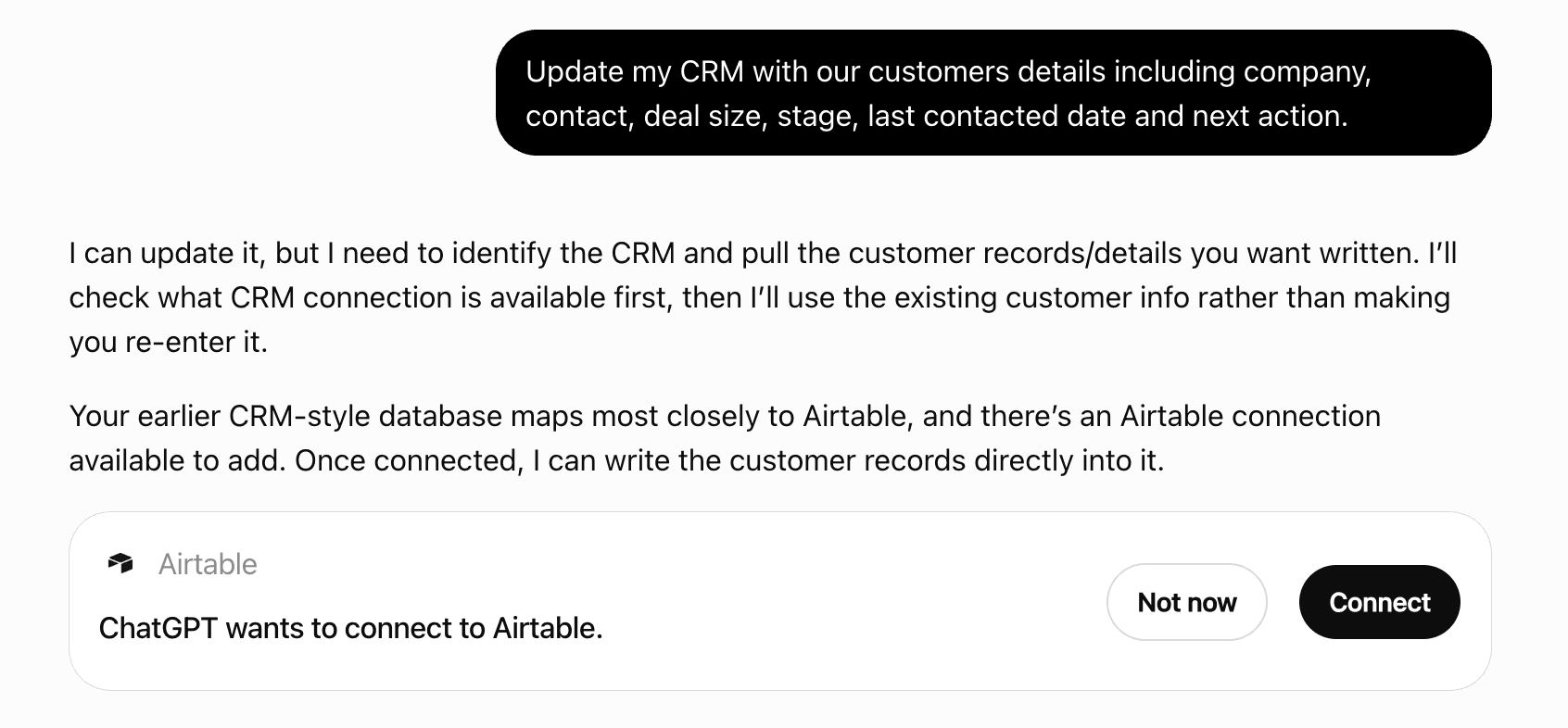
Get alerts for EcoCheck
Get updates when EcoCheck’s Discoverability Score or category rank changes.
Competitive lineup
53 tools agents can invoke
Workspace owner only, Full access AI level: ACTIVE or INACTIVE (an inactive member cannot sign in to the workspace). Confirm with the user before deactivating someone.
set_workspace_member_status
Recorded activity data of a year with computed emissions (kg). With journal_id: one entry and its evidence files.
get_journals
Creates an empty reporting year (status REPORTING, open for data) in an inventory. Use clone_inventory_year to copy the structure of an existing year instead.
create_inventory_year
Copies system template accounts (with their calculation settings) into a year. Include the parent groups. Ids from lookup_reference template_accounts.
add_accounts_from_template
Calculates the current model of a product and returns the footprint without saving anything (also on a locked year): kg CO2e per declared unit, stages, processes, top contributions, gases, data quality, other indicators. mode=uncertainty: Monte Carlo (95 % interval) · mode=scenarios: the baseline and every scenario of the product (save_lca_model entity=scenario) · mode=sensitivity: one-at-a-time parameter sensitivity (each parameter ± delta_pct, default 10 %). To keep a result, use save_lca_product action=save_result or action=finalise.
calculate_lca
scope=workspace (owner): cancels a workspace invitation (invitation_id from get_workspace_admin). scope=organization / inventory: cancels the invitation sent to email. Ask the user first.
cancel_invitation
Sets the role (READ / WRITE) of an organization or inventory member (user_id from get_organizations / get_inventories with include_members). Needs the Full access AI level.
change_member_role
REPORTING = open for data (INIT is accepted and stored as REPORTING). LOCKED / FINISHED, or unlocking, need the Full access AI level and the OWNER role; a workspace that requires review refuses LOCKED (REVIEW_REQUIRED: submit for review in the app); a locked year refuses data changes. Confirm with the user before locking or finishing a year.
set_inventory_year_status
Copies a year (accounts, calculation settings, assessments, CBAM structure; no activity data) into a new year of the same inventory or of to_inventory_id.
clone_inventory_year
Updates a journal and recalculates. data: emission_account_id, facility_id, startBookDate, endBookDate, input, source, data_quality, note, dq_technology, dq_time, dq_geography, dq_completeness, dq_reliability (1-5), data_type (PRIMARY | SECONDARY), uncertainty_percent.
update_journal
entity=installation: English profile (data = {name_en, country_code, unlocode, latitude, longitude, registry_installation_id, operator_name_en, contact_email…}). entity=process: no id = create (data = {name, category, activity_level_t, route?, electricity_consumed_mwh?, electricity_ef_source?, heat_*?, waste_gas_*?, params?}), id = update. entity=good (process_id): CN code (data = {cn_code, name_en?, quantity_t?}). entity=precursor (process_id): {source INTERNAL + source_process_id | PURCHASED + cn_code, origin_country?, verified?, see_direct?, see_indirect?, quantity_t} (with id: full replacement). entity=source_stream: {name, method COMBUSTION|PROCESS|MASS_BALANCE|MEASUREMENT, process_id?, gas?, activity_data?, ncv? (TJ / unit), emission_factor?, oxidation_factor?, carbon_content?, biomass_fraction?, measured_t?}. Categories: CALCINED_CLAY, CEMENT_CLINKER, CEMENT, ALUMINOUS_CEMENT, NITRIC_ACID, AMMONIA, UREA, MIXED_FERTILISERS, HYDROGEN, SINTERED_ORE, PIG_IRON, FERRO_MANGANESE, FERRO_CHROMIUM, FERRO_NICKEL, DRI, CRUDE_STEEL, IRON_STEEL_PRODUCTS, UNWROUGHT_ALUMINIUM, ALUMINIUM_PRODUCTS
save_cbam_data
No inventory_id: create (data = {organizationId, name 5-255, type CORP|LCA|PROJECT, facilityIds [], interestedCertIds [] REQUIRED, at least one (lookup_reference certificates, e.g. ISO 14064-1 / GHG Protocol), reportingPurpose? COMPLIANCE_ND06|CBAM|VOLUNTARY (sets GWP AR5/AR6), years? [{code:"2025", isBaseYear:true}]}). With inventory_id: update (name, type, gwp, reportingPurpose, facilityIds…).
save_inventory
Workspace admin only (space owner; members get 403): the workspace's own factors. System library factors are maintained by EcoCheck. Deleting a value used by an emission source is refused (409 FACTOR_IN_USE). kind=family, no id: create a factor family (data = {sector_code, category_code, lca_method_code, organizationIds [], name?}); kind=value, no id: add a value (data = {meta_code, source_code (lookup_reference custom_factor_sources, not factor_sources), year_code, region_code, unit_code, supported_calculation_methods [], co2e_val? or co2_val / ch4_val / n2o_val}); with id: update.
save_custom_factor
No facility_id: create (data = {organizationId, name 5-255, type OFFICE|PLANT|OTHER, address {street, zip, province, countryId, cityId}}). With facility_id: update.
save_facility
No action_id: create (data = {title, subCategoryId (lookup reduction_sub_categories), description?, reduceEmissionPotential?, inventoryEmissionAccountId?, quantity?}). With action_id: update.
save_reduction_action
No target_id: create (data = {title, baseYear, targetYear, annualEmissionReduction %, totalEmissionReduction %, scope ["SCOPE1",…], inventoryYearId, baseYearEmission, nextYearEmission, targetYearEmission}). With target_id: update data, toggle_status (ON TRACK <-> INACTIVE) and / or action_ids (replace the linked reduction actions).
save_target
No organization_id: create (data = {name 5-255, type SME|GOV|CORP|NGOV|EDU|INS|NON_PROFIT_ORG|OTHER, address {street, zip, province, countryId, cityId}, sectorIds [], mainContact {firstName?, lastName?, phone?, email?}, interestedCertIds?}). With organization_id: update the given fields.
save_organization
action=create: new product of the year; template = a built-in template key or template_id = an organization template (lct_…), both from lookup_lca_library templates, to start from a ready model (then set its parameters with save_lca_model entity=parameter), or data = {name, unit (e.g. kg, piece, m2), demand_amount, description?, system_boundary? CRADLE_TO_GATE|CRADLE_TO_GRAVE, method_gwp? ar6|ar5, facility_id?} for an empty model; name is required either way. action=update: product_id + data (same fields; doc_en {product, description, company, facility, address, activity, processes {lcq_…: name}} = English names for English documents; epd_declared {PERM, PENRM, SM, RSF, NRSF, HWD, NHWD, RWD, CRU, MFR, MER, EEE, EET} = declared resource / waste indicators of the EPD). action=clone: product_id + data {name, variant_note?} = an ecodesign variant. action=save_template: product_id + data {name, description?} saves the model as a template of the organization. action=save_result: saves the current calculation as a result (note?). action=finalise: FINAL saves a result and freezes the model (needed for PACT); action=reopen: back to DRAFT.
save_lca_product
No account_id: create (data = {name, year_id, type GROUP|LEAF, parent_code e.g. "S1.001", scope3_category? 1-15, calculation_method_instance? for LEAF {calculation_code "EF.102", data {emission_factor: <row of lookup_reference emission_factors> + factor_unit = unit.code + system_factor_value_ref_id = id}}}). With account_id: update fields, or set excluded (true / false + exclude_reason) to move it out of / back into the boundary.
save_emission_account
Deletes: organization, facility (refused while it has journals or CBAM data), inventory, year (with its accounts, journals, CBAM data), emission_account (a group with its children and journals), journals (ids), custom_factor (a value, cfv_…), custom_factor_family (a family, cf_…; delete its values first), target, reduction_action, target_action_link (target_id + id), cbam_process, cbam_good, cbam_precursor, cbam_source_stream. Ask the user first.
delete_records
Deletes a product footprint (with its model and results), a process (with its inputs), an input, a co-product, a parameter or a scenario (the product must be DRAFT for these), a parameter of the year (global_parameter_id) or an organization template (template_id). Ask the user first.
delete_lca_records
view: installations (facilities as CBAM installations + status) · data (profile, processes, CN goods, precursors, source streams) · result (specific embedded emissions per CN code, Reg (EU) 2025/2547, AR5, default-value comparison, warnings) · saved_result · default_value (cn_code, country): exact CN8 code from the customs declaration; when the Act prints no row for it, `candidates` lists the printed codes with the same prefix — pick the matching one, do not substitute another heading.
get_cbam
Processes, inputs, co-products, parameters and scenarios (the product must be DRAFT). entity=global_parameter: a parameter shared by every product of the year (no product_id needed; data = {name, value, unit?, description?}; global_parameter_id to update). entity=scenario: a named set of parameter values to compare (data = {name, values {parameter: value}, description?}; scenario_id to update); calculate_lca mode=scenarios compares them. entity=coproduct: a co-product of a process, for allocation (process_id; data = {name, amount or amount_formula, unit, mass_kg_per_unit?, price_per_unit?}; coproduct_id to update; the process allocation_method PHYSICAL | ECONOMIC | MANUAL is set with entity=process). entity=parameter: the quantities of a template model are parameters (get_lca view=product lists them with unit and meaning, all 0 in a new product): data = {name, value} sets one by name (or parameter_id + data); data.values = {name: value, …} sets several at once; a new name creates it (data = {name, value, unit?, description?, formula?}). entity=process: no process_id = create (data = {name, unit, ref_amount?, is_reference?, stage? RAW_MATERIAL|PRODUCTION|DISTRIBUTION|USE|END_OF_LIFE, module? A1…D, mass_kg_per_unit?}), with process_id = update; background_key = copy a background unit process into the model. entity=input: process_id + no input_id = create (data = {kind BACKGROUND (factor_key from lookup_lca_library factors) | FOREGROUND (input_process_id = another process of the model) | EMISSION (gas co2|ch4|ch4_fossil|n2o|co2e or flow_uuid), amount or amount_formula, unit, label?, uncertainty_pct?, dqr_te/dqr_ge/dqr_ti 1-5?}), with input_id = update; input_id + background_key = turn that background input into an editable process of the model (its unit process copied). entity=derived_input: process_id + source facility_inventory (data = {facility_id, scopes [1,2,3], share_percent, output_quantity}) | cbam (data = {facility_id, cn_code, quantity_t}) | cff (Circular Footprint Formula of a material) | supplier_pact (data = {footprint: PACT JSON, quantity}).
save_lca_model
Chart of emission sources of a year (tree by code / parent_code). type=LEAF lists the accounts activity data can be recorded on. With account_id: one account with its calculation method and emission factor.
get_emission_accounts
Totals of an inventory year in t CO2e: by scope, source, facility, Scope 3 / ISO 14064 categories, excluded and biogenic. summary.market_based: Scope 2 location-based vs market-based (contractual instruments such as I-REC / DPPA; grid factor as residual mix). summary.consolidation: totals by the organisation's consolidation approach (operational / financial control, equity share). summary.base_year: base-year recalculation status (cumulative change vs threshold).
get_emissions_report
kind=inventory: GHG inventory report / certificate (.docx, needs facility_id; counts toward the plan export quota); report_template_code ISO_14064_1 = organisation-wide ISO 14064-1:2018 report (clause 9.3 content, no facility_id). kind=reduction: emission-reduction report (.docx, Decree 06 template RE_ND_06; needs facility_id and target_id). A refusal listing missing_fields names the profile fields to complete first.
export_report
Documents of a saved result (result_id): report = ISO 14067 carbon footprint study report (.docx) · epd = draft Environmental Product Declaration (ISO 14025 / EN 15804+A2, .docx, the basis for third-party verification) · ilcd = ILCD+EPD data set (.zip, for EPD programmes) · pact = PACT v3 ProductFootprint (JSON, FINAL results only). The model of a product (no result_id): workbook = Excel bill of materials (.xlsx) · jsonld = openLCA JSON-LD (.zip) · simapro = SimaPro CSV · ecospold2 = EcoSpold2 (.zip). workbook_template = blank Excel import template (no product_id). lang vi (default) or en for report / epd. Importing files back (Excel, JSON-LD, SimaPro, EcoSpold) is done on ecocheck.ai.
export_lca_document
A facility (plant, site, building) with address and technical blocks.
get_facility
Full content of a search result: an organization, a facility, or an inventory with its years and latest emissions summary.
fetch
Freezes the CBAM data of the installation-year (status FINAL): further edits are refused until reopen_cbam_report. Refused while the result has ERROR warnings. Confirm with the user first.
finalise_cbam_report
Without inventory_id: list inventories (optionally of one organization). With inventory_id: details (GWP set, reporting purpose), reporting years with status, linked facilities and (include_members) members.
get_inventories
Detailed guidance before acting: journal input per calculation method, CBAM workflow, permissions, data model, Scope 3 categories. Call it when unsure how to fill a write tool.
ecocheck_guide
Copies Scope 1 CO2 / N2O of the facility journals into CBAM source streams of the installation (CH4 is not a CBAM gas). Re-running keeps the process attributions.
import_cbam_from_inventory
Sends an invitation e-mail. scope=workspace (owner): invite to the workspace. scope=organization / inventory: invite with role READ or WRITE. Needs the Full access AI level. Confirm the address with the user first: e-mails cannot be recalled.
invite_member
Sends an invitation e-mail to an external expert (consultant, verifier) for an organization, limited to the given inventories. Needs the Full access AI level. Confirm with the user first: e-mails cannot be recalled.
invite_expert
kind: factors (search emission factors / unit processes of the background databases by words, query required; use the returned key as factor_key of a BACKGROUND input) · dataset (one background dataset by key) · indicators (impact indicators besides GWP) · sources (background databases, licence, attribution) · templates (built-in product templates: metal-parts, garment, plastic-packaging, wood-furniture, agri-food, steel-rolling, aluminium-die-casting, corrugated-box; and the organization's own) · elementary_flows (substances for site EMISSION inputs, query required) · cbam_goods (CBAM goods of the year with their specific embedded emissions, to reuse in a footprint) · facility_inventory (GHG inventory totals of a facility in the year, facility_id).
lookup_lca_library
Workspaces (subscriptions) of the signed-in customer: name, subscriptionCode, role. Call first: every other tool needs `workspace`.
list_workspaces
The signed-in user (id, e-mail, workspaces with role) and their AI-assistant access level in a workspace (NONE / READ / WRITE / FULL, set by the workspace owner). Use it to explain refused actions.
get_my_access
Without organization_id: list organizations of the workspace. With organization_id: details, facilities, inventories and (include_members) members and pending invitations.
get_organizations
kg CO2e of a quantity on a LEAF account, nothing saved. The quantity is in the unit of the account's emission factor (EF.102, e.g. kWh), or in the account's own input unit when it converts (EFC.102: unit_conversion.unit_conversion, e.g. litres of diesel, never pre-converted); for a refrigerant source (Air.101) it is the kg of refrigerant released, valued with the inventory's GWP set.
preview_emission
Product carbon footprints (ISO 14067, cradle-to-gate or cradle-to-grave) of an inventory year. view: products (every product with its latest saved result, kg CO2e per declared unit, stages, top contributions) · product (the model: processes, inputs with factor_key / amount, parameters, issues; needs product_id) · results (saved results of a product) · result (one saved result: totals, stages, processes, top contributions, gases, data quality, uncertainty, other indicators; needs result_id) · checks (rule check of a saved result against standard iso14067 | en15804 | pef) · compare (product_ids, first = base, per declared unit, nothing stored). Needs the LCA feature of the plan.
get_lca
Books activity data on a LEAF account; EcoCheck computes the emissions. input per method (get_emission_accounts account_id shows calculation_code): EF.102 {value, entry_unit} (e.g. {"value": 1200, "entry_unit": "kWh"}), EFC.102 {value} in the own input unit of the account (unit_conversion.unit_conversion, e.g. litres of diesel — never pre-converted), DI.101 {value} (kg CO2e), Air.101 {amount_val}, S3.SPEND {amount, currency, spend_year}, Scope 3 methods S3.TRAVEL {trips}, S3.TRANSPORT {legs}, S3.COMMUTE {headcount, working_days, modes}, S3.ASSET, S3.PROCESSING, S3.HYBRID, S3.SUPPLIER, S3.FERA, S3.USE, S3.WASTE, S3.PCAF (inputs with examples: ecocheck_guide scope3_categories). Optional data quality fields dq_technology … dq_reliability (1-5), data_type, uncertainty_percent. Dates inside the year; a period over two years is split automatically. dry_run=true only previews. An identical entry (same account, facility, period and input) already recorded is not booked again: the answer is skipped_duplicate with the existing journal; book it anyway only if the user confirms it is a separate entry (allow_duplicate=true).
record_activity
Without target_id: targets (optionally of a year) and the reduction-action catalogue. With target_id: the target and its linked actions.
get_targets
Lookups for the write tools: emission_factors (search the system library: every word of query in any order across names (EN / VI), activity id and description; ranked region (asked, else VN) > official Vietnamese sources > other official sources; filters unit_type / region / year / source), emission_factor (id), custom_emission_factors, account_templates (query: words of the EN or VI name / description, accents optional, e.g. "nam 2026" or "det may" also find the Vietnamese names), template_accounts (id = template; compact rows: code, name, scope / category, method, factor id + values + unit + source code, settings; paged, default 100 per page, meta.hasNextPage; factor detail via emission_factor id), calculation_methods, gwp (code e.g. ar5_100), units, unit_types, sectors, factor_categories, lca_methods, factor_sources (official registry: code, publisher, dataset, edition, licence, attribution, row counts), custom_factor_sources (source codes accepted by save_custom_factor values), factor_regions, factor_years, countries, cities (id = country), certificates, report_templates, assessment_templates, accuracy_templates, reduction_categories, reduction_sub_categories, organization_types, facility_types, inventory_types, enum (code = enum name), scope3_metadata (Scope 3 categories, methods with their input keys, recommended methods, airports, currencies), scope3_factor_sets (code = Scope 3 category 1-15: recommended official factor sets with row counts and sample rows; region = supplier country ranked first, e.g. VN; suspect rows have a lost decimal point).
lookup_reference
scope=workspace (owner): removes the member from the workspace and its organizations. scope=organization / inventory: removes the member from it. Ask the user first.
remove_member
Moves a finalised CBAM installation-year back to DRAFT so its data can be edited.
reopen_cbam_report
Sends the pending organization or inventory invitation e-mail again. Needs the Full access AI level.
resend_invitation
Stores the current CBAM result of the installation-year as a draft snapshot (get_cbam view=saved_result reads it back).
save_cbam_result
items = significance [{id, assessments: [{criteria_code, value {value}}]}] or accuracy [{id, accuracies: [{criteria_code, value {…}}]}] (ids from get_assessments).
save_assessment
Search the customer's organizations, facilities (plants, sites) and GHG inventories by name across their workspaces. Returns ids for fetch.
search
 Recommended guideHow to get your ChatGPT Plugin suggestedFollow the practical steps agents use to find, shortlist, and choose your Plugin.Read guide
EcoCheck ChatGPT Plugin FAQ
How the directory, categories and Discoverability Score work.
Read the methodologyHow do I improve EcoCheck's ChatGPT Plugin discoverability?
The levers are the listing surface agents actually read: names, descriptions, keywords, tool metadata, and registry health. Which lever matters depends on where discovery breaks, which is what continuous measurement shows.
Where is this profile measured?
This profile uses the geography attached to the latest public registry snapshot: US. Locale tags are intentionally omitted.