



Block Scholes
Derived and aggregated market data (RWA & Crypto): implied vol surfaces, modelled option prices, forwards, funding, OI and volume, index history from 2020, plus any arbitrary points and a back tester.
 View in the Claude registry
- Brand
- Block Scholes
- Category
- Data & Analytics
- Primary Subcategory
- Institutional Financial Data & Equity Research Platforms
Integration details
Description
Block Scholes provides derived and aggregated market data for derivatives, not just raw quotes. This connector lets Claude query it directly and backtest strategies on it, so you can ask in plain language and get the numbers back. What you can do - Get derived data: implied volatility by delta, strike or moneyness, SVI parameters, skew and butterfly, and constant-maturity volatility indices (listed expiries or constant maturities). - Price options off the volatility surface: model-implied prices at strikes and expiries that are not listed, where the service supports it. - Read constant-maturity forward prices (such as 30 days), plus funding rates, annualised futures rates and the Block Scholes Risk Appetite Index. - Use data aggregated across venues by the Block Scholes exchange (index and theoretical prices, bid, ask and trade averaged across venues, summed volume and open interest), or per-venue index, bid, ask, mid and trade prices, open interest and volume, across spot, perpetuals, futures and options; coverage varies by venue. - Go back in time: Block Scholes series run back to 2020 where applicable. - Interact with arbitrary points on the volatility surface or forward curve. - Look up which instruments, expiries and strikes are listed on each venue. - Backtest option, futures, perpetual and spot positions, with optional delta hedging. Example questions - "Chart BTC 30-day implied vol and 25-delta skew over the last 90 days." - "How would a short 7-day ETH straddle held to expiry have performed each week this quarter?" - "Compare SOL perpetual funding on Binance and OKX for the past week." Requirements Sign in with a Block Scholes account when you connect. Full access needs a Block Scholes entitlement; accounts without one get limited, rate-limited access. All tools are read-only: they never place orders or move funds, and backtests are simulations. Documentation: https://docs.blockscholes.com/mcp/overview
- Integration type
- Connector
- Verification status
 Community connector
- Platform
- Claude
- Primary Subcategory
- Institutional Financial Data & Equity Research Platforms
- Secondary Subcategories
- None listed
- Brand
- Block Scholes
- Access
- Account required
- First tracked
- 2026-11-03
- Tool count
- 3
- Market
- US
The Primary Subcategory used for this profile’s headline score.
Other Subcategories where the Integration is listed.
 Agent DiscoverabilityClaude Discoverability Score
Claude Connector discovery is coming soon
Community Connectors only appear in Claude’s registry.Once verified, organic discovery begins and we can calculate your score.Read more about Community Connector verification.
No spam. Unsubscribe any time.
What discovery looks like
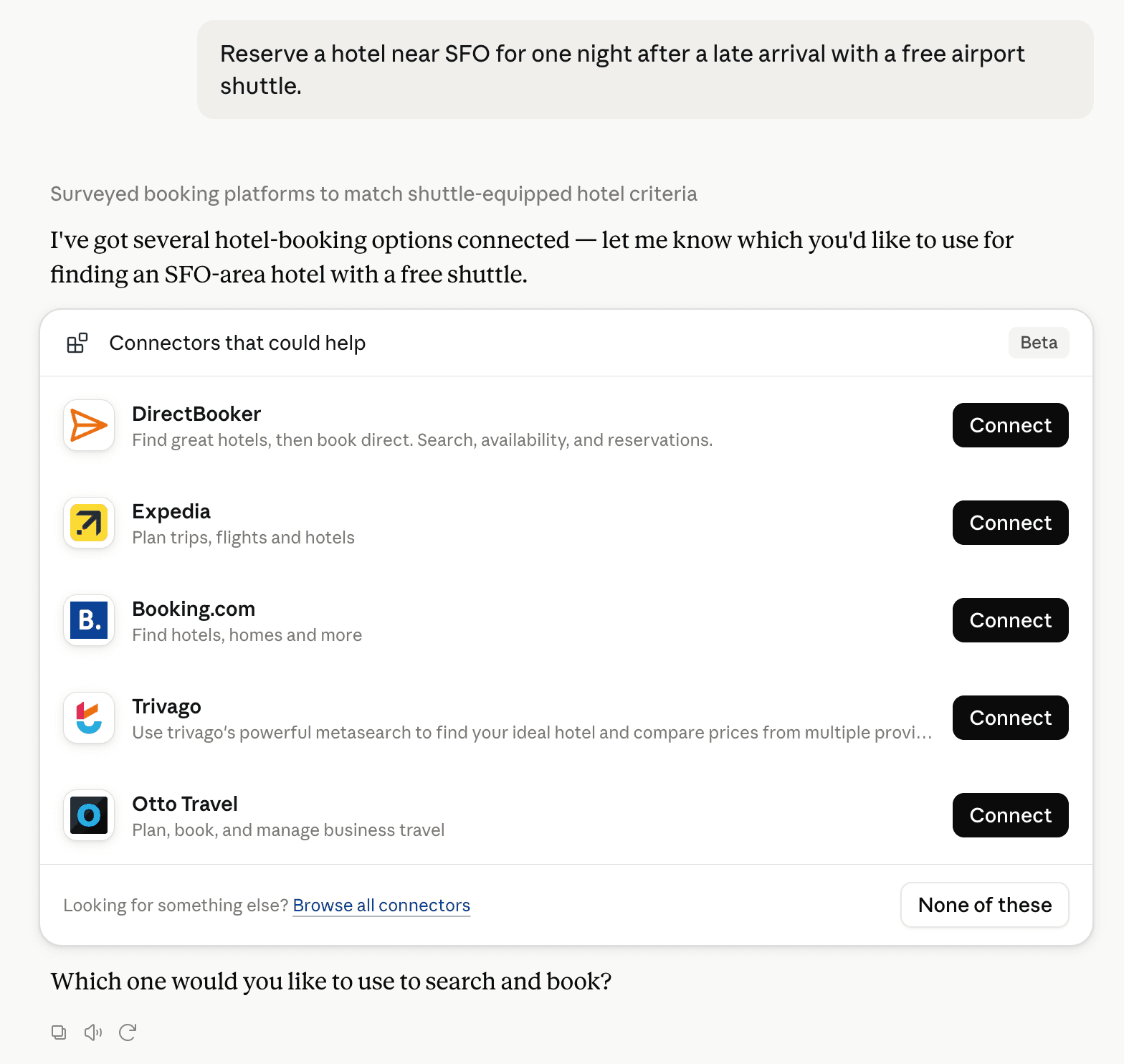
Claude can surface verified Connectors when they match a user’s Prompt.
How Claude Connector discovery works
Your Connector will compete to appear for users’ Prompts once Claude verifies it
Competing in Claude Institutional Financial Data & Equity Research Platforms
View Category
3 tools agents can invoke

Block Scholes Claude Connector FAQ
How the directory, categories and Discoverability Score work.
Read the methodologyHow do I improve Block Scholes's Claude Connector discoverability?
The levers are the listing surface agents actually read: names, descriptions, keywords, tool metadata, and registry health. Which lever matters depends on where discovery breaks, which is what continuous measurement shows.
What are Block Scholes alternatives on Claude?
As of 2026-11-04, Block Scholes competes with Daloopa, Financial Datasets, Bigdata.com, FactSet AI-Ready Data, Alpha Vantage MCP Server, FMP, Clear Street, viaNexus vAST and 152 more in Claude Institutional Financial Data & Equity Research Platforms, ranked by public Discoverability Score.
Where is this profile measured?
This profile uses the geography attached to the latest public registry snapshot: US. Locale tags are intentionally omitted.