



Quantum Expectations
Reality-check quantum computing claims with sourced data: whether a computation runs on today's hardware, what it would take, and how fast records are improving.
 View in the Claude registry
- Brand
- Quantum Expectations
- Category
- Data & Analytics
- Primary Subcategory
- Scientific & Biomedical Research Data
Integration details
Description
See for yourself what today's quantum computers can actually do, and how far they are from the applications in the headlines. You do not need to be a physicist: ask in plain language, and Claude runs the numbers on real hardware records, each one taken from a published source. Is it realistic yet? Paste a paper, a press release, a roadmap or a headline and compare its claims with today's hardware, or describe a computation or pick one of the example algorithms and see how likely today's best hardware is to get it right, with and without error correction. What would it take? See how much better the hardware would have to get, and how many physical qubits and how much run time a well-known goal such as breaking RSA-2048 needs once error correction is included. How fast is progress? Compare trapped-ion, superconducting and neutral-atom hardware side by side, follow the record error rates and qubit counts over the years, and see when the trend would reach a target if it held (an extrapolation, not a forecast). The answers to the first two questions show their assumptions and caveats, and every hardware record links to the paper or vendor publication it comes from. The tools give numbers, not verdicts: what they mean for quantum computing stays your judgement. For experts, the same tools take exact inputs: qubit count, circuit depth, per-gate error rate, surface-code distance, qLDPC codes, and logical qubits with T count for full fault-tolerant footprints (Litinski cost model). Limitations: this is a deliberately simplified model. It treats noise with the standard surface-code approximation and a routing allowance for hardware with fixed connections, and leaves out effects such as leakage, crosstalk, measurement errors, single-qubit gate errors and idling. Where a measured benchmark score and the model disagree, the measurement wins. All tools are read-only and take no personal data.
- Integration type
- Connector
- Verification status
 Community connector
- Platform
- Claude
- Primary Subcategory
- Scientific & Biomedical Research Data
- Secondary Subcategories
- None listed
- Brand
- Quantum Expectations
- Access
- No account required
- First tracked
- 2026-11-09
- Tool count
- 13
- Market
- US
The Primary Subcategory used for this profile’s headline score.
Other Subcategories where the Integration is listed.
 AgentDiscoClaude Discoverability Score
Claude Connector discovery is coming soon
Community Connectors only appear in Claude’s registry.Once verified, organic discovery begins and we can calculate your score.Read more about Community Connector verification.
No spam. Unsubscribe any time.
What discovery looks like
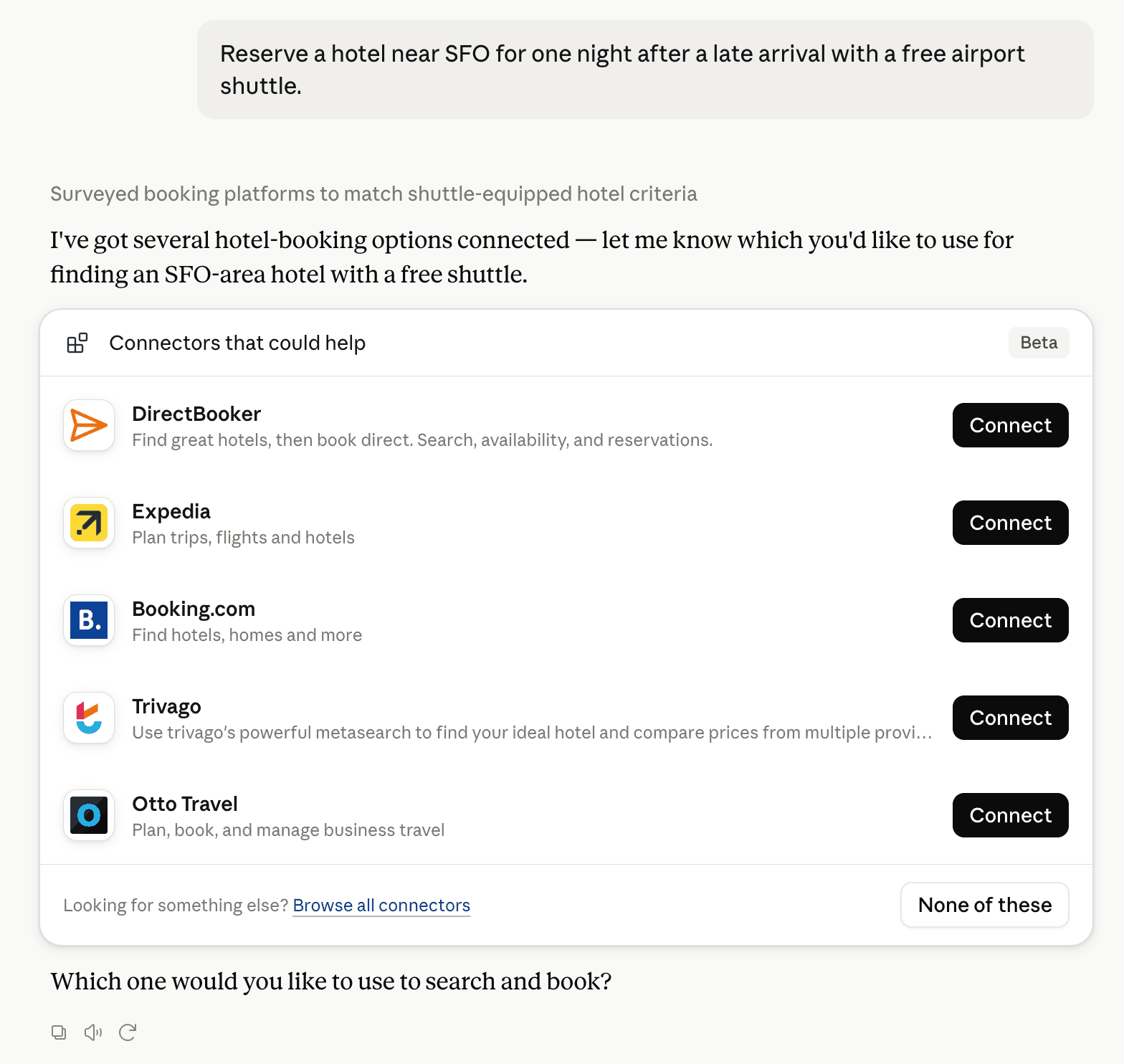
Claude can surface verified Connectors when they match a user’s Prompt.
How Claude Connector discovery works
Your Connector will compete to appear for users’ Prompts once Claude verifies it
Competing in Claude Scientific & Biomedical Research Data
View Category
13 tools agents can invoke

Quantum Expectations Claude Connector FAQ
How the directory, categories and Discoverability Score work.
Read the methodologyHow do I improve Quantum Expectations's Claude Connector discoverability?
The levers are the listing surface agents actually read: names, descriptions, keywords, tool metadata, and registry health. Which lever matters depends on where discovery breaks, which is what continuous measurement shows.
What are Quantum Expectations alternatives on Claude?
As of 2026-11-10, Quantum Expectations competes with Amass Connector, Boltz API, Synthesize Bio, Elicit, Addgene, Arca Life Sciences, Atomscale, Benchling and 36 more in Claude Scientific & Biomedical Research Data, ranked by public Discoverability Score.
Where is this profile measured?
This profile uses the geography attached to the latest public registry snapshot: US. Locale tags are intentionally omitted.