
GovBot Water Quality
Water-quality measurements from U.S. Geological Survey sampling sites via the USGS and EPA Water Quality Portal: nearby sites, site and county summaries, federal reference levels. Read-only.
 View in the Claude registry
- Brand
- GovBot.ai
- Category
- Data & Analytics
- Primary Subcategory
- Scientific & Biomedical Research Data
Integration details
Description
GovBot Water Quality is a remote, read-only MCP server operated by Ideation Lab, Corp. It requires no account. It reports measurements from U.S. Geological Survey sampling sites, read through the Water Quality Portal, a U.S. Geological Survey and U.S. Environmental Protection Agency service; EPA's own WQX data are not included. Every result states the publisher, unit, sample dates and retrieval time. What it returns: - Sampling sites within 25 km of a point (wells, streams, lakes, springs), with coordinates, county, well depth where reported and the number of results held. - Per-site summaries for chloride, sulfate, total dissolved solids, iron, manganese, fluoride, nitrate and arsenic: number of results, first and last sample date, median, minimum, maximum and non-detects. - Individual results for one site and one constituent in a date range. - County summaries for one constituent and site type since a given year: sites, results, the median of site medians and the number of sites whose median is above each reference level. - The federal reference levels in 40 CFR 143.3 and 40 CFR 141.62(b), with citations and the date the tables were read. Typical use: see which wells or streams near a place have been sampled and for what, read one site's results over time, or summarize one constituent across a county. How results are qualified: results are measurements of raw water at monitoring and study sites, not treated tap water and not a statement about any household. Sites are those the agencies chose to sample, not a complete or random set. A comparison with a reference level is arithmetic on published values, not a finding about whether water is fit to drink; 40 CFR 143.1 describes the secondary levels as not Federally enforceable. Not affiliated with the U.S. Geological Survey, the U.S. Environmental Protection Agency or any government agency. The server writes nothing.
- Integration type
- Connector
- Verification status
 Community connector
- Platform
- Claude
- Primary Subcategory
- Scientific & Biomedical Research Data
- Secondary Subcategories
- None listed
- Brand
- GovBot.ai
- Access
- No account required
- First tracked
- 2026-11-23
- Tool count
- 6
- Market
- US
The Primary Subcategory used for this profile’s headline score.
Other Subcategories where the Integration is listed.
 AgentDiscoClaude Discoverability Score
Claude Connector discovery is coming soon
Community Connectors only appear in Claude’s registry.Once verified, organic discovery begins and we can calculate your score.Read more about Community Connector verification.
No spam. Unsubscribe any time.
What discovery looks like
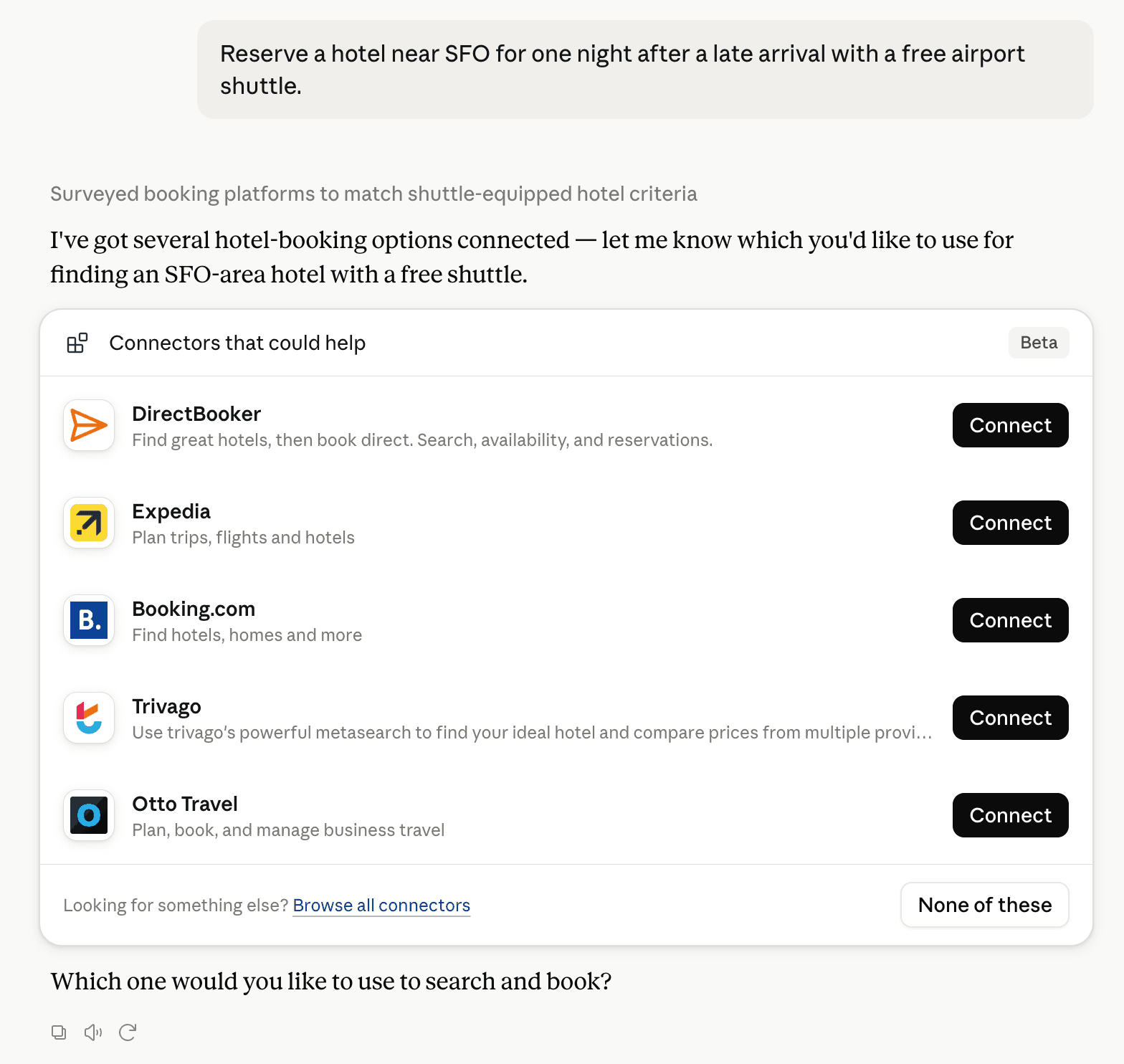
Claude can surface verified Connectors when they match a user’s Prompt.
How Claude Connector discovery works
Your Connector will compete to appear for users’ Prompts once Claude verifies it
Competing in Claude Scientific & Biomedical Research Data
View Category
6 tools agents can invoke

GovBot Water Quality Claude Connector FAQ
How the directory, categories and Discoverability Score work.
Read the methodologyHow do I improve GovBot Water Quality's Claude Connector discoverability?
The levers are the listing surface agents actually read: names, descriptions, keywords, tool metadata, and registry health. Which lever matters depends on where discovery breaks, which is what continuous measurement shows.
What are GovBot Water Quality alternatives on Claude?
As of 2026-11-24, GovBot Water Quality competes with Amass Connector, Synthesize Bio, Addgene, Arca FDA, Trials & PubMed, Atomscale, Benchling, BESTPRED, Chart to Data and 43 more in Claude Scientific & Biomedical Research Data, ranked by public Discoverability Score.
Where is this profile measured?
This profile uses the geography attached to the latest public registry snapshot: US. Locale tags are intentionally omitted.